SunGiga G2 Plus
522kWh IEC
522kWh IEC
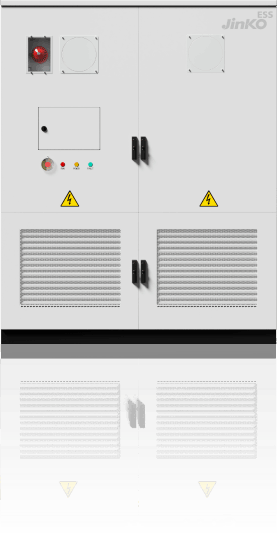
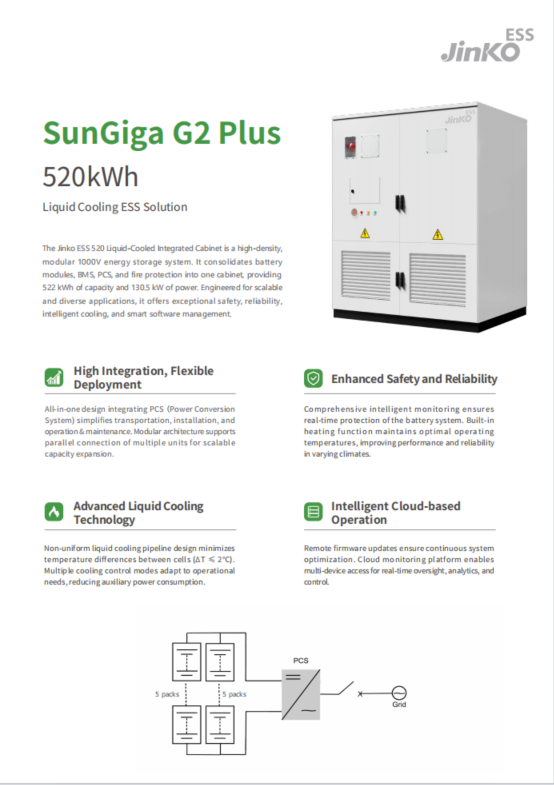
The Jinko ESS 520 Liquid-Cooled Integrated Cabinet is a high-density,modular 1000V energy storage system. It consolidates battery modules, BMS, PCS, and fire protection into one cabinet, providing 522 kWh of capacity and 130.5 kW of power. Engineered for scalable and diverse applications, it offers exceptional safety, reliability, intelligent cooling, and smart software management.
Key Advantages

Flexibly Deployed
Integrated design simplifies installation and O&M. Modular architecture enables flexible capacity expansion
2.8㎡
↓ 10%
Integrated Design – Footprint
522kWh~3.13MWh
Flexible Capacity Expansion
- Integrated Design – Footprint: 2.8㎡ ↓ 10%
- Flexible Capacity Expansion: 522kWh~3.13MWh

Reliable Operation
Intelligent monitoring and interlocks protect batteries in real time. Fire detection, gas suppression and built-in heating ensure rapid response and temperature control
≤3s
Alarm Response Time
≤30s
Heating Response Time
- Alarm Response Time: ≤3s
- Heating Response Time: ≤30s

Refined liquid cooling keeps cell temperature differentials within ≤2°C, while multiple modes reduce auxiliary power consumption
≤2℃
Cell Temperature Differential
↓ 20%
Aux. Power Consumption
≥90%
System RTE
- Cell Temperature Differential: ≤2℃
- Aux. Power Consumption: ↓ 20%
- System RTE: ≥90%

Efficient Management
Remote OTA upgrades enable continuous optimization, with cloud-based monitoring and multi-device access
≤15 min
OTA Time / Unit
≤60s
Data Refresh Rate
- OTA Time / Unit: ≤15 min
- Data Refresh Rate: ≤60s
Applications
Commercial Buildings
Lower electricity costs through peak shaving;
backup power for critical loads;
improved energy efficiency.
improved energy efficiency.
PV-Storage-Charging Stations
Balance EV charging loads;
maximize PV self-consumption;
reduce charging costs;
prevent grid overload.
maximize PV self-consumption;
reduce charging costs;
prevent grid overload.
Industrial Parks
Peak-valley arbitrage;
demand management;
uninterrupted production;
renewable energy integration.
demand management;
uninterrupted production;
renewable energy integration.
Infrastructure
Backup power for reliable supply;
defer grid expansion;
support peak shaving and frequency regulation.
defer grid expansion;
support peak shaving and frequency regulation.
Microgrid
Balance distributed energy fluctuations;
power critical loads during islanded operation;
improve energy self-sufficiency.
power critical loads during islanded operation;
improve energy self-sufficiency.
Specifications
 DC Side
|
|
| Cell Type | LFP 3.2V/314Ah |
| Nominal Capacity | 522 kWh |
| Rated Voltage | 832 Vdc |
| Nominal Voltage Range | 728V~936V |
| Pack Quantity | 10 pcs |
| Max. Charge/Dischage Power | 0.25 P |
| System Configuration | 2P260S |
 AC Side
|
|
| Rated AC Power | 130.5 kW |
| Rated Voltage | 400 Vac |
| AC Connection | 3P4W |
| Rated Frequency | 50/60 Hz |
| THDi | <3% |
 General Parameters
|
|
| Life cycle | 8000 @70%EOL |
| Operating Temperature | -30℃~55℃, derating > 45°C |
| Operating Humidity | ≤95%RH, without condensation |
| Operating Altitude | ≤3000m |
| Ingress Protection | IP55 (Cabinet); IP66 (PCS) |
| Corrosion Protection Class | C3 (C5 Optional) |
| Fire suppression system | System aerosol gas extinguisher + Somke detection + Temperature sensing + Flammable gas detection |
| Cooling Method | Liquid cooling |
| Max. Parallel Quantity | 6 Units in parallel |
| Communication Protocol | RS485/CAN/Ethernet |
| Dimensions(W×D×H) | 1920x1430x2400 mm |
| Weight | ≈5,000 kg |
| Compliance Standards | IEC 62619, IEC 62477, IEC 60730, IEC 63056, IEC 61000, IEC 62040, IEC 62933, UN 38.3, UL 9540A, NFPA 69 |


Follow us