SunTera G2
5.01MWh IEC
5.01MWh IEC
The Jinko 5.01MWh liquid-cooled ESS integrates 314Ah LFP cells, advanced thermal management with 20% lower auxiliary power consumption, and intelligent O&M for reliable, safe, and cost-effective grid-scale energy storage.
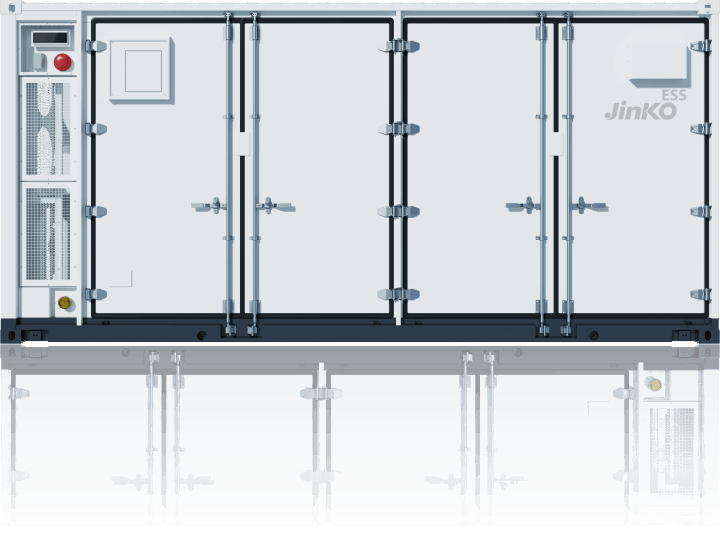
Key Advantages

Refined flow channels keep cell temperature differentials within ≤2°C, while multiple cooling modes reduce auxiliary power by 20%
≤2°C
Cell Temperature Differential
↓ 20%
Auxiliary Power Consumption Reduction
- Cell Temperature Differential: ≤2°C
- Auxiliary Power Consumption Reduction: ↓ 20%

Rack-level management boosts RTE by >2%, while active balancing improves cell consistency
≥94% (0.5P)
≥95% (0.25P)
≥95% (0.25P)
DC RTE
↑>1%
Usable Energy
-
DC RTE: ≥94% (0.5P)
≥95% (0.25P) - Usable Energy: ↑>1%

Five-level cell-to-system protection helps prevent thermal runaway, with integrated gas and water fire suppression
5-tier
Protection Architecture
EN1364-1
Fire Suppression
Battery/HV
physically isolated
physically isolated
Cabin Design
UL9540A 2026
Certifications
- Protection Architecture: 5-tier
- Fire Suppression: EN1364-1
-
Cabin Design: Battery/HV
physically isolated - Certifications: UL9540A 2026

Intelligent control simplifies commissioning and reduces O&M costs. Flexible placement maximizes site energy density.
≤30 min
OTA Upgrade Time
<1s
Remote O&M Latency
Leak-free swap
+ front access
+ front access
Maintenance
- OTA Upgrade Time: ≤30 min
- Remote O&M Latency: <1s
-
Maintenance: Leak-free swap
+ front access
Applications
Generation-side
Stabilize and optimize renewable energy output
while supporting grid stability.
while supporting grid stability.
Grid-side
Support grid dispatch for peak shaving and frequency regulation,
improving system flexibility and stability.
improving system flexibility and stability.
User-side
Reduce grid load, meet diverse energy needs,
and improve power supply reliability for end users.
and improve power supply reliability for end users.
Specifications
|
|
|
| Type of cell | Lithium Iron Phosphate(LFP) |
| Cell specification | 3.2V/314Ah |
| Charge/discharge power | 0.25P/0.5P |
| Configuration of system | 1P416S×12 |
| Rated capacity | 5.01 MWh |
| Rated voltage | 1331.2V |
| Voltage range | 1164.8~1497.6V |
|
|
|
| Dimension(L×W×H) | 6058×2438×2896mm |
| Weight | 42,000 kg |
| Cooling method | Liquid Cooling |
| Operating temperature | -30~50°C |
| Operating humidity | ≤95%RH, no condensation |
| Altitude | ≤3,000m (derating above 2000 m) |
| Noise level | ≤80dB(A), @1m/ 75dB(optional) |
| IP grade | IP55 |
| Corrosion class | C4/(C5 optional) |
| Fire protection | Temperature sensor + Smoke detector + Combustible gas detector + Alarm bell + Fire suppression system + Deflagration venting(optional) + Pressure relief port + Manual emergency start/stop button + Ventilation system + Water sprinkler |
| Communication | Ethernet / Modbus TCP/IP |
| Certification standards | IEC62619, IEC63056, IEC62933, IEC62477, IEC61000, UN38.3, UL1973, UL9540, UL9540A |
Downloads


Follow us