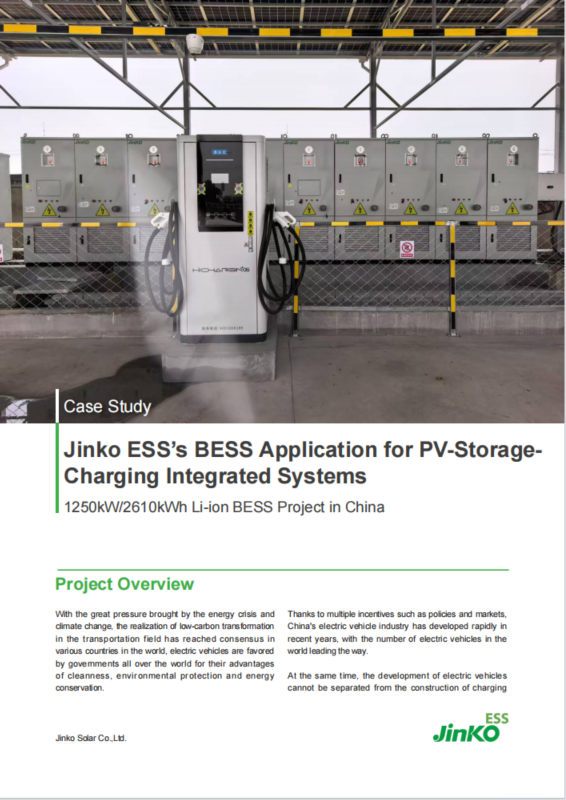
Designed for integrated solar, storage and EV charging,
Jinko EMS coordinates PV generation, battery storage and charging loads
to shift energy, maintain a stable power supply and provide dynamic capacity support,
increasing solar self-consumption and reducing total electricity costs.

SunGiga Series: Built with in-house 314Ah cells and non-uniform flow-channel liquid cooling, maintaining cell temperature differentials within ≤2°C . Pre-integrated with battery modules, BMS, PCS and fire protection, it supports both grid-connected and off-grid operation. G2 (261 kWh) and G2 Plus (522 kWh) enable flexible capacity expansion. For PV-storage-charging applications, EMS coordinates PV, storage and EV charging loads to dynamically optimize charging power and transformer capacity, maximizing PV self-consumption.

EMS 1000 Station-Level Energy Management System: Powered by in-house AI algorithms, it optimizes storage revenue through load forecasting and electricity market strategies. Functions include grid-connected/off-grid switching, anti-backflow, demand control, PV utilization, PV-storage coordination, black start, peak shaving and TOU arbitrage. Compatible with major communication protocols, third-party devices and grid dispatch interfaces. Eight-level visualization from device to station enables efficient O&M via Web, APP and large-screen platforms.

Tiger Neo 3.0: High-efficiency N-type TOPCon bifacial modules delivering 650–670 W front-side power and an 85±5% bifaciality factor, with a temperature coefficient as low as -0.26%/°C . Optimized cell architecture and encapsulation enhance low-light performance and resistance to PID, LID and LeTID. Certified for 5,400 Pa front-side load, ensuring stable long-term generation.


The EMS platform intelligently coordinates PV generation, battery storage and charging loads across the site. Fine control of EV chargers and other flexible loads maximises solar self-consumption and reduces reliance on the grid.

When transformer or grid-connection capacity is constrained, charging power is adjusted automatically to maintain stable site operation, while the energy storage system is dispatched in real time to provide additional capacity support.

The energy storage system shifts demand away from peak periods, reduces the site's maximum demand and optimises electricity costs.